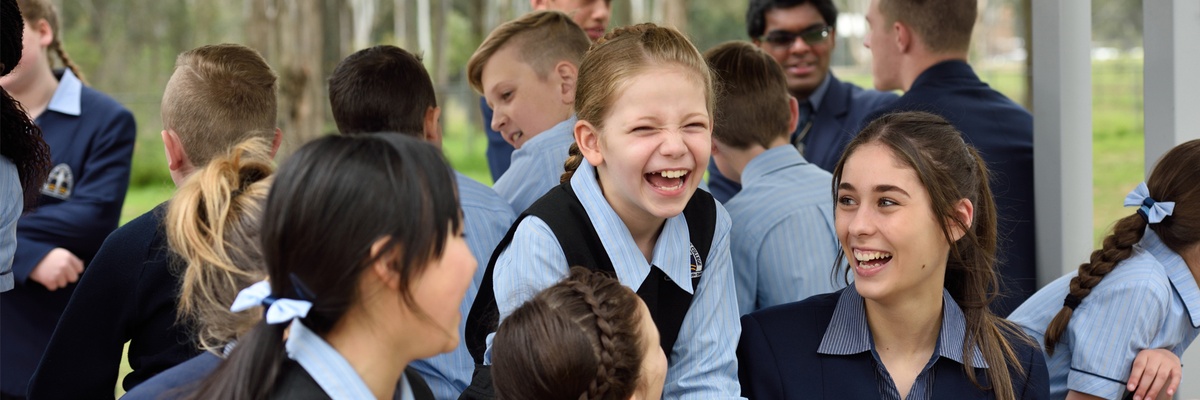
A physically, emotionally and academically safe, and calm environment is at the heart of every positive learning experience. When students feel secure, they are far more able to engage deeply, take risks in their learning, and build confidence in who they are becoming. It is important that throughout the school day, students know what to expect, trust the teachers around them, and feel supported to navigate challenges.
In the Junior School, we help to create this safe and calm environment by focusing on five important ideas.
1. Having clear rules and guidelines for behaviour
both in the classroom and around the College.
For example, our WALK acronym that provides clear descriptions of the way that students move around the College.
- W – Walking in a straight line
- A – At a steady pace
- L – Lips closed (no sound)
- K – Keeping our hands by our sides and our feet on the track.
If you have ever attended a Junior School Chapel or Assembly, you will have seen this acronym in action.
2. Explicitly teaching routines and procedures in the classroom .
Children thrive on routine. Predictable patterns give them a sense of security and help them develop the habits that underpin strong learning. In the Junior School, students are taught routines in their classroom such as where to line up before class, how books are handed out, what to do when they have finished a task, how to set out their page, and how to write a sentence.
To ensure that all students are involved in their learning, teachers also use routines to check for understanding and encourage all students to participate in a lesson. These include routines include the use of individual whiteboards, sharing ideas with their learning partners, hand gestures for answering questions, whole class choral responses.
3. Praising and celebrating positive behaviours and learning success
Teachers use verbal praise, stickers, rewards and stamps to recognise students who are behaving and learning in a way that supports their own and their peers’ learning. When students receive recognition for their effort, kindness, or growth, it reinforces the message that their actions matter and that they are valued members of our community.
Positive acknowledgement builds confidence and promotes a sense of belonging, which in turn reduces anxiety and helps children approach challenges with a calmer mindset. Celebrating success creates a culture where students feel safe to try, safe to make mistakes, and safe to take pride in their progress.
4. Giving fair and appropriate consequences when students have not demonstrated positive behaviours.
There are times when students need to stop and reflect on something negative that has happened. Teachers work hard to ensure they understand the event that has taken place. Giving a small, age-appropriate consequence helps students to reconsider their actions and contribute more positively in the future.
It can be challenging for parents to imagine their children doing something that requires a consequence. Teachers don’t do this lightly, they carefully try to understand what has happened before determining their response.
5. Diligently ensuring that all spaces are safe and calm .
It is important that our physical surroundings are safe for students. We do this by:
- Providing a variety of spaces for students to play in. We have grassy spaces for students who want to run, quad spaces for students who want to play quieter games, and the Year 3-6 library. In addition, we provide quiet spaces when student need some additional support.
- Teachers are on duty from 8:30am until lineup at 8:55am, during the two breaks of the day, and at the end of the day until 3:40pm (later if they are on bus duty).
- Blue lines that help keep students safe are currently being repainted in the Junior School. These lines help students know whether they can go to an area without a teacher supervising them. We have also added blue lines at the pickup gates in K Block to ensure that students are standing back when cars pull up to pick them up.
Things you can do to help
- It is important not to drop your children at school before 8:30am as there is no supervision. This means that there are no teachers nearby if something happens to your child. There are currently several parents dropping their children before this time, particularly in the H-J quad. I would like to emphasise that there is no supervision before 8:30am.
- Please do not allow your children to play on the play equipment at K or L Block when you are picking up children. We would appreciate your support in this way as it can be confusing for students who are told they can only play there with teacher supervision to be left to their own devices.
- If you are using the L Block carpark, please close the gate up to K Block as you come in or leave. This will help to keep students from wandering onto the road.
- Please stay away from the H-J quad and nearby classrooms until 3:20pm so that students can learn in a quiet and calm space.
A safe and calm environment is not created by one person or one strategy alone. It is a shared responsibility that involves the whole school community working together. Children take cues from all the adults in their lives and when there is consistency between home and school this helps them to feel grounded and secure. Teachers play an essential role in modelling calm and respectful interactions, and parents can help to reinforce these messages both at school and at home.
Students can also contribute to the environment by respecting others, participating positively in their classroom community, following the rules and caring for their peers. When all three groups work together, the impact can be powerful.